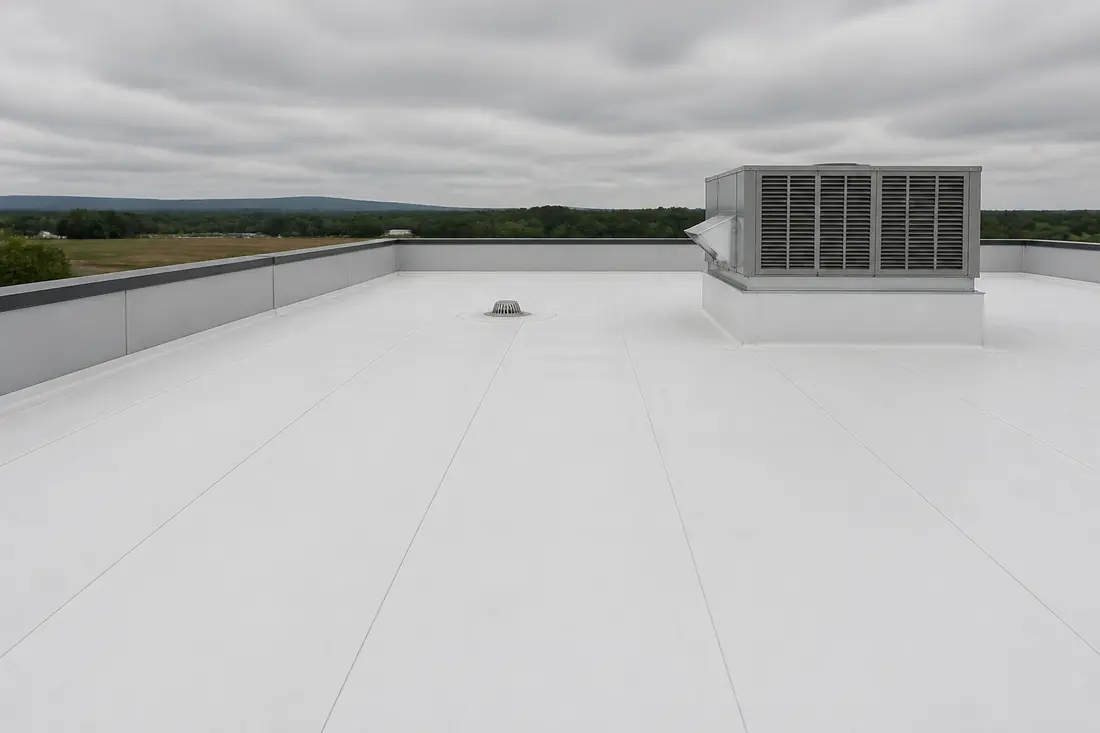
TPO Roofing
Heat-welded TPO single-ply membrane — the reflective white system most new North Alabama commercial roofs are built with.
Free estimateDetails
Commercial roofing for North Alabama industrial, retail and institutional buildings — inspection through installation.
Commercial roofing for North Alabama industrial, retail and institutional buildings — inspection through installation.
Mon–Fri 7:00am – 5:00pm · Sat By appointment · Sun Closed
Straight through to a person, not a phone tree.
Tell us what is going on and we will get back to you with the next step.
We work around your operations
Occupied buildings do not stop for a roof. Phasing, night and weekend work, and protection of what is underneath are planned before mobilisation, not improvised on day one.
Drainage assessed before membrane
Most premature membrane failure we are called to is a drainage problem wearing a membrane costume. Slope, drains and scuppers get surveyed before anyone specifies a system.
Written scope, photographed condition
You get a documented scope and photographs of what was found and what was done, which is what a facility manager needs for a capital file and an insurer needs for a claim.
Installed to manufacturer specification
Fastener patterns, seam widths and flashing details follow the system manufacturer’s published requirements, because that is what a material warranty is conditioned on.
Repair quoted against replacement
When a roof is near end of life we price the repair and the replacement side by side with remaining service life on each, rather than selling whichever is larger.
Clean sites, protected tenants
Debris containment, magnet sweeps and protected walkways matter more on an occupied retail or medical building than on any residential job.
Commercial roofing for North Alabama industrial, retail and institutional buildings — inspection through installation.
Water entering a roof runs along the deck, along insulation joints, and down structural members before it drops through a ceiling. On a large low-slope roof the entry point can be a long way from the stain, and chasing the stain is how buildings end up with a dozen patches and the same leak.
Investigation means checking the obvious suspects in order — penetrations, curbs, drains, seams and terminations upslope of the interior evidence — and then testing rather than guessing. Water testing an area under controlled flow confirms a suspicion before anyone commits to a repair.
Where a roof has widespread saturation, moisture surveying maps the wet insulation rather than sampling blindly. That distinguishes a roof with three bad spots from a roof that is soaked and needs replacing, and those two deserve very different quotes.
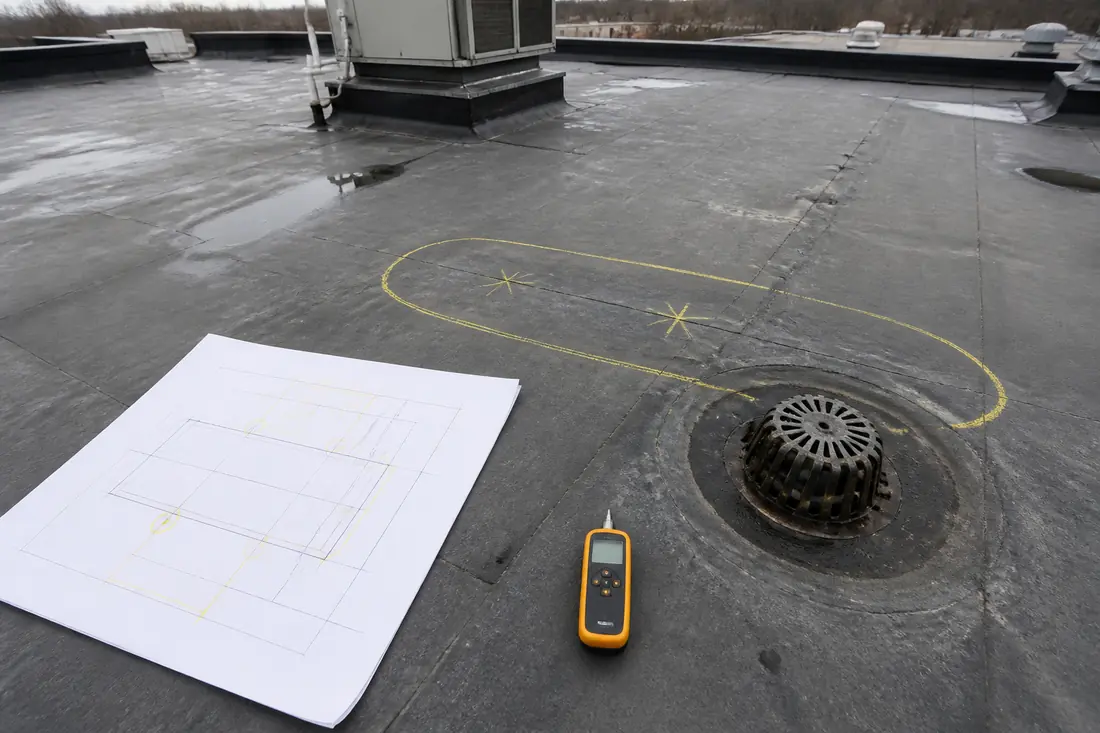
Most commercial roof repairs are seams, flashings and penetrations. The field of a membrane rarely fails on its own; it fails where it was cut, joined, or wrapped around something. That is where we look first.
A repair that does not address the cause is a repair you will pay for again. If a seam opened because the membrane is being pulled by a substrate that is moving, patching the seam buys a season. We tell you which of those you are looking at before quoting.
On a roof genuinely near end of life we will say so and price the replacement alongside, with remaining service life on each option. Selling repairs into a roof that needs replacing is profitable and dishonest, and it is the fastest way to lose a facility manager permanently.
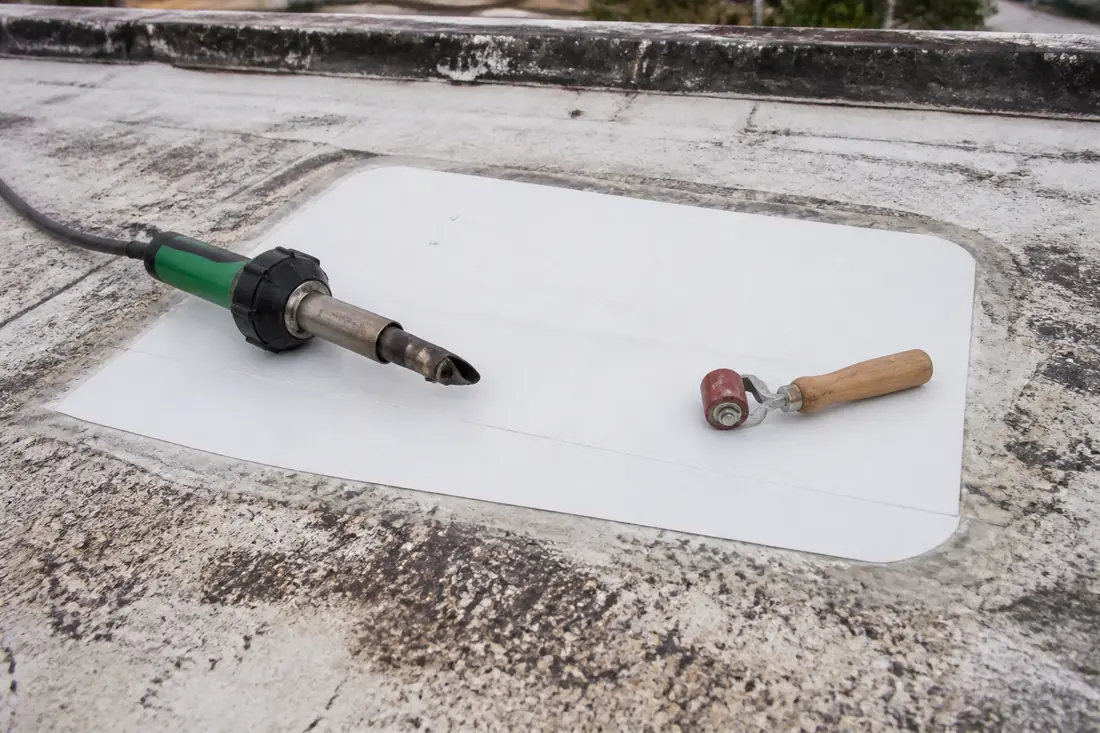
TPO is one of the most widely specified single-ply commercial roofing systems in the United States. Its heat-welded seams, reflective surface options and range of attachment methods make it a common choice for low-slope commercial buildings. Properly heat-welded seams create a continuous membrane assembly when installed and tested according to the manufacturer's requirements. They do not depend on an adhesive that ages at a different rate to the membrane.
In Huntsville's hot summer climate, reflective roof surfaces can reduce solar heat gain and may help reduce cooling loads on conditioned buildings. The appropriate membrane color and assembly should be selected based on the building, insulation, energy requirements and project specifications.
Many TPO problems occur at seams, flashings, penetrations and other installation details. Proper welding, detailing and quality-control inspections are critical to long-term performance. Welds run too cold or too fast do not fuse, and the failure shows up two or three years later at a seam rather than immediately. Heat-welded seams are inspected and tested as required by the roofing system manufacturer and project specifications, with deficient welds repaired and retested before completion.
A tear-off is the only way to know what is actually under a roof. Recovering over a wet or deteriorated assembly traps the moisture and buys a shorter life than the new membrane deserves. When we open a roof we photograph the deck condition before anything goes back on.
The part that decides whether a commercial replacement goes well is sequencing. Only as much roof comes off in a day as can be made watertight before the crew leaves, and on an occupied building that constraint drives the whole schedule rather than the other way round.
Deck repair, insulation replacement, drainage correction and new flashing all belong in the replacement rather than being deferred. A tear-off is the one time those are cheap to fix, because everything is already open.
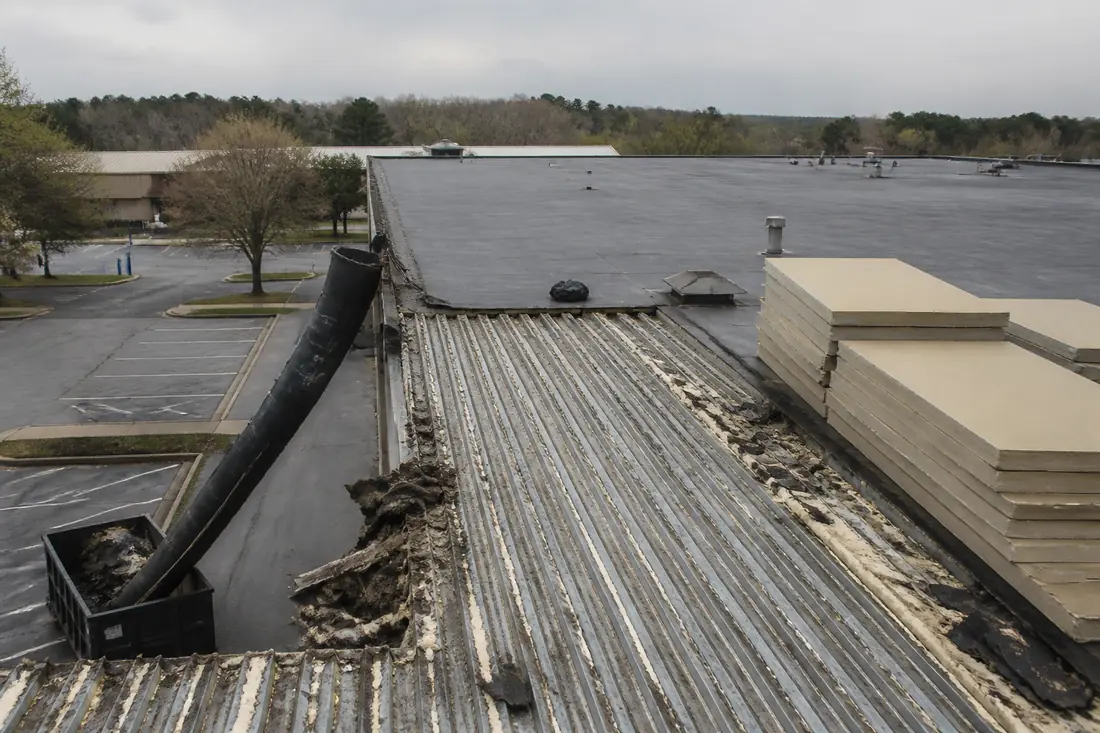
Heat-welded TPO single-ply membrane — the reflective white system most new North Alabama commercial roofs are built with.
Heat-welded TPO single-ply membrane — the reflective white system most new North Alabama commercial roofs are built with.
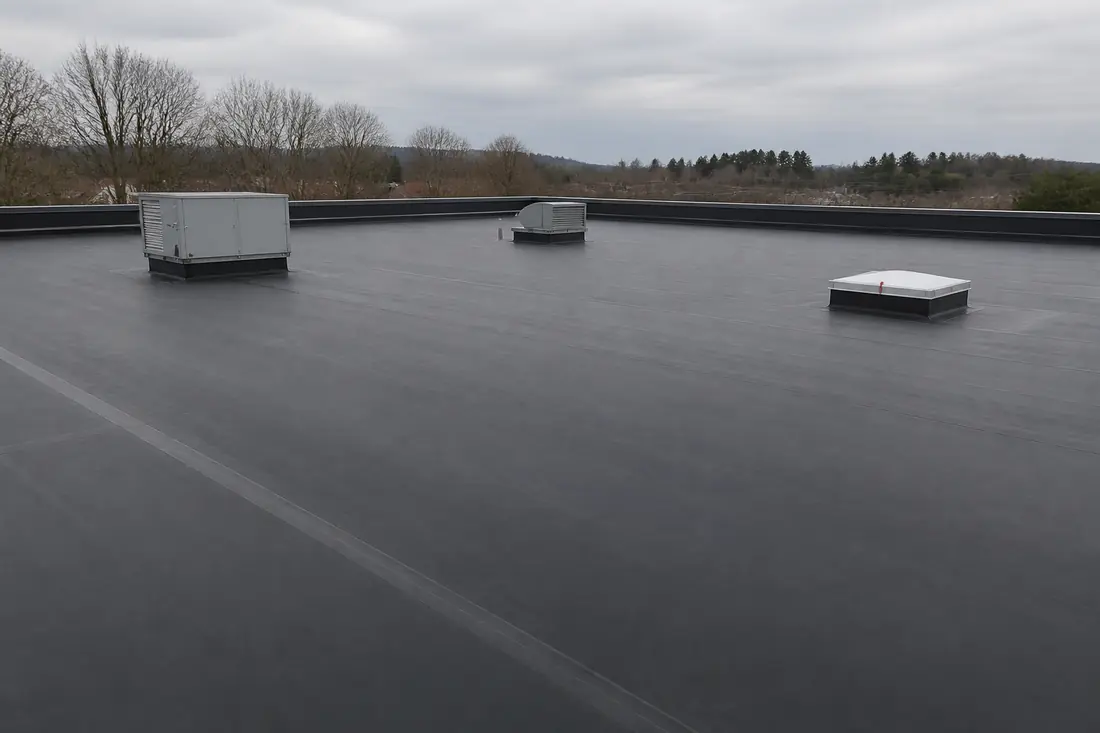
EPDM rubber membrane roofing — the longest field track record of any single-ply system, in black or white.
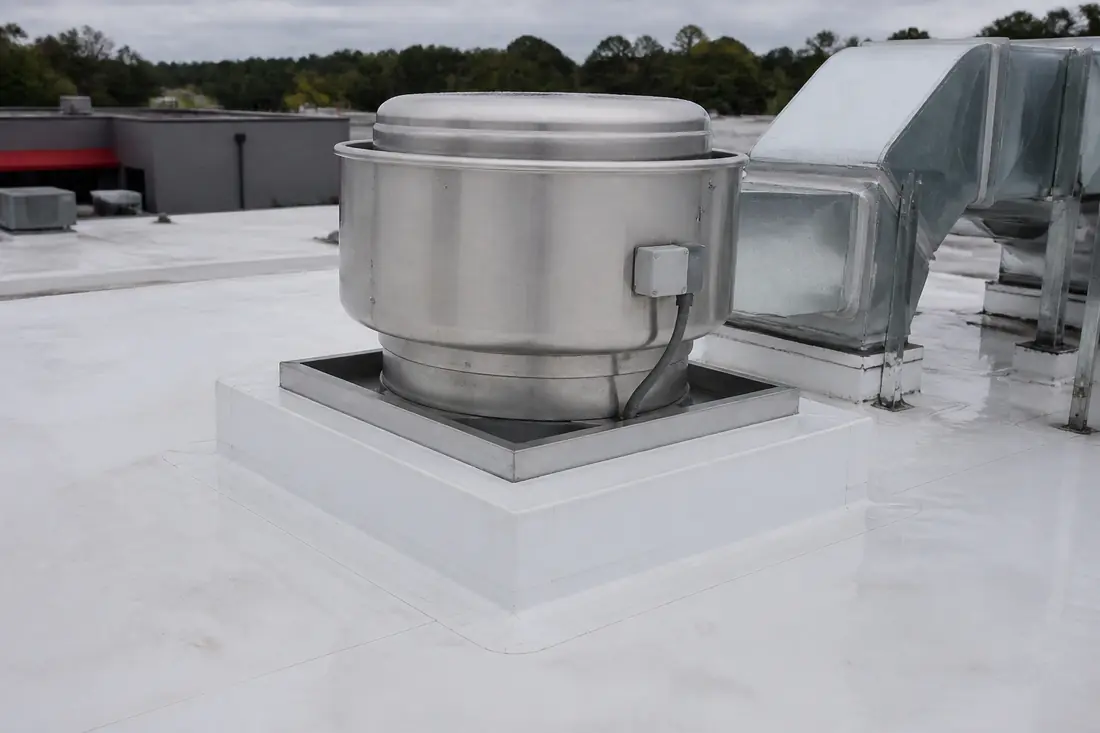
Heat-welded PVC membrane for buildings that exhaust grease, oils or chemicals — restaurants, food processing and manufacturing.
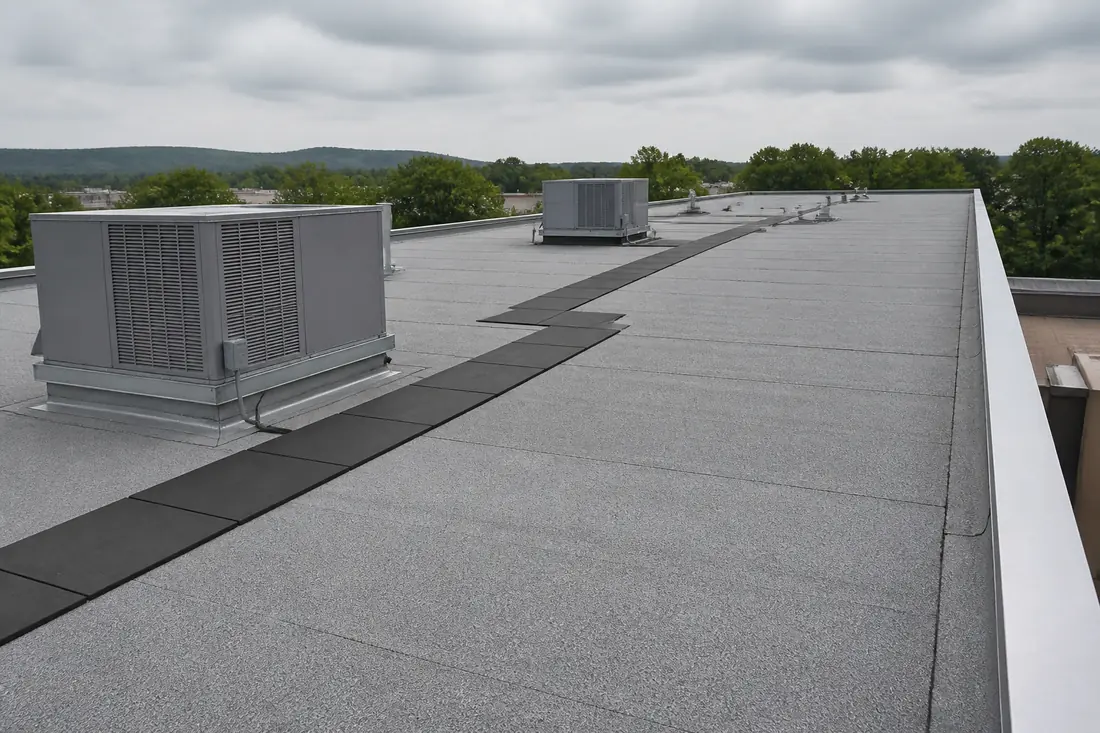
Multi-ply modified bitumen systems for roofs that take foot traffic, rooftop equipment and regular servicing.
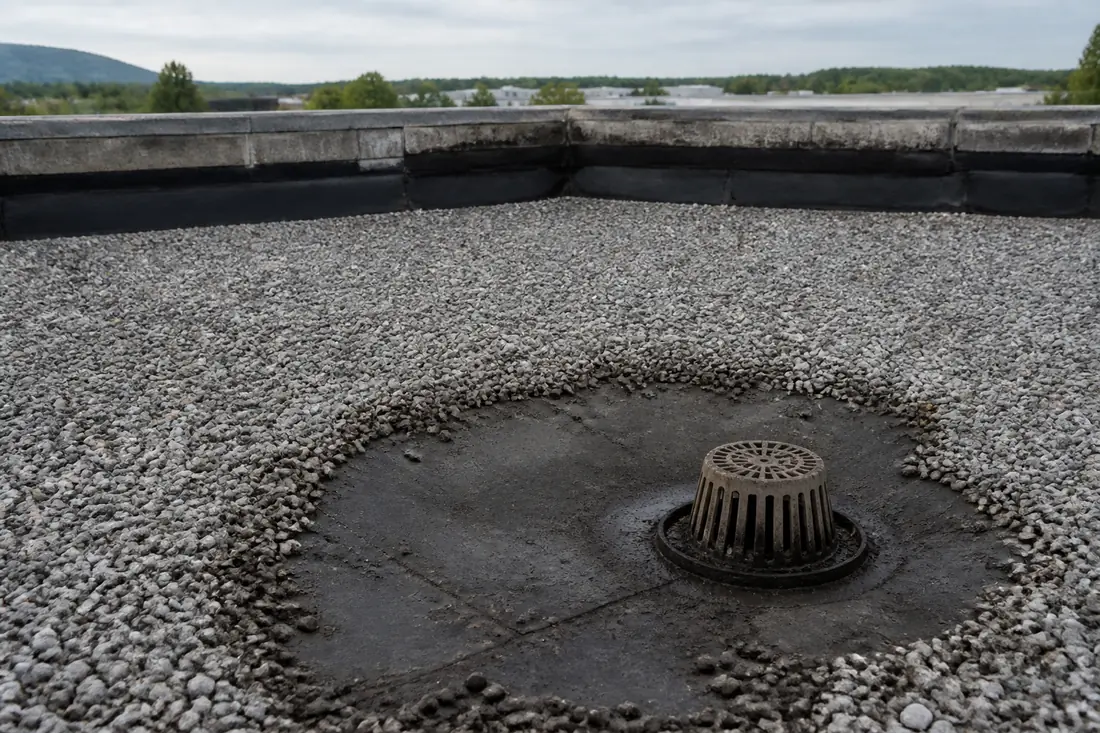
Traditional multi-ply built-up roofing — alternating bitumen and reinforcing felts with a gravel or cap surfacing.
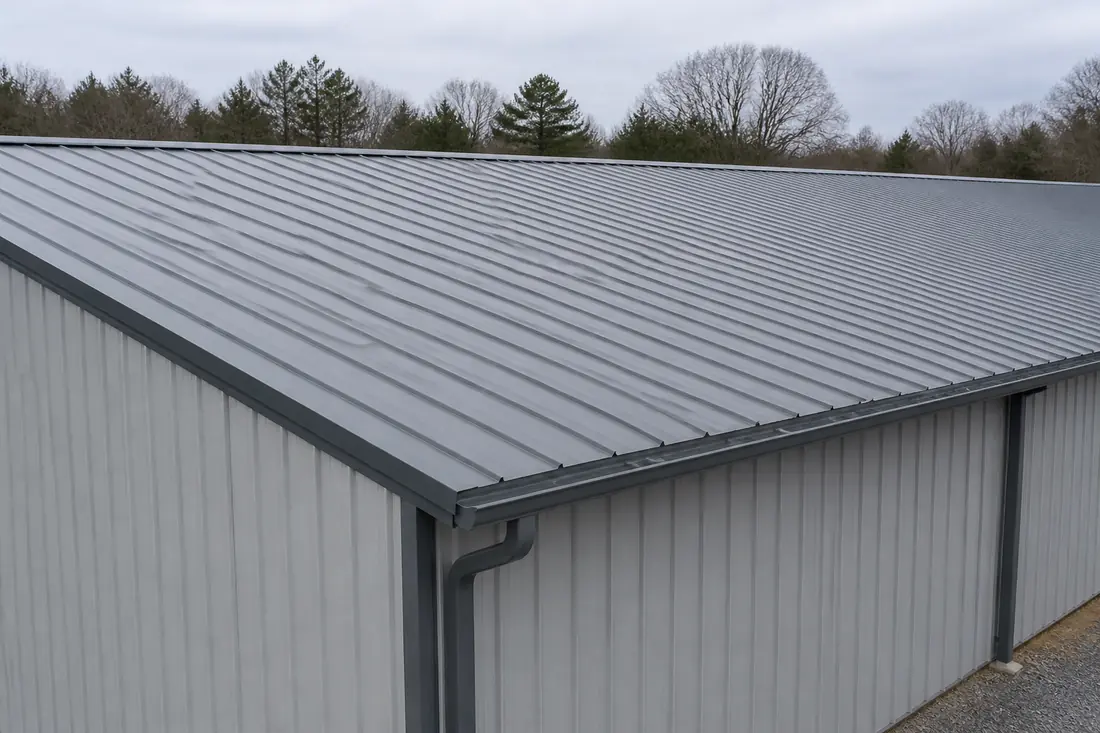
Standing seam and exposed-fastener metal roofing for warehouses, agricultural buildings and steep-slope commercial.
Full removal down to deck, deck repair, and a new roof assembly — phased so the building keeps operating.
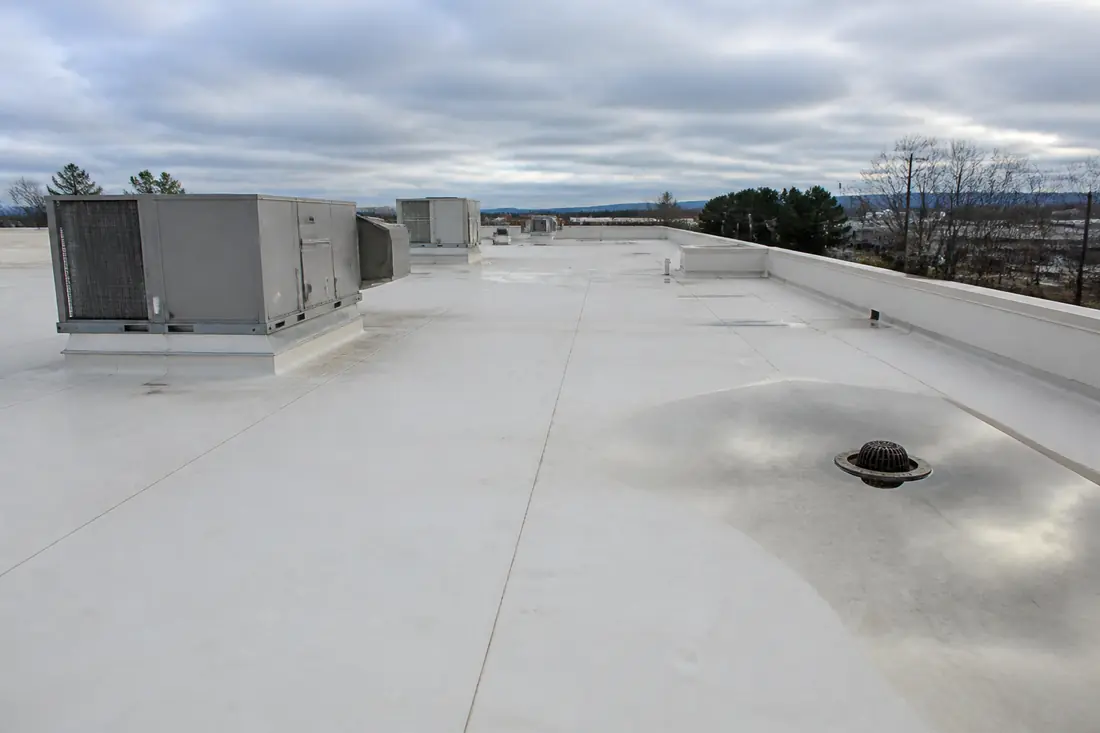
Repair, replacement and maintenance for the low-slope roofs most people call flat — TPO, EPDM, PVC, modified bitumen and built-up.
Targeted repair of seams, flashings, penetrations and membrane damage — after establishing why it failed.
Targeted repair of seams, flashings, penetrations and membrane damage — after establishing why it failed.
Finding where water actually enters, which is rarely above where it appears inside the building.
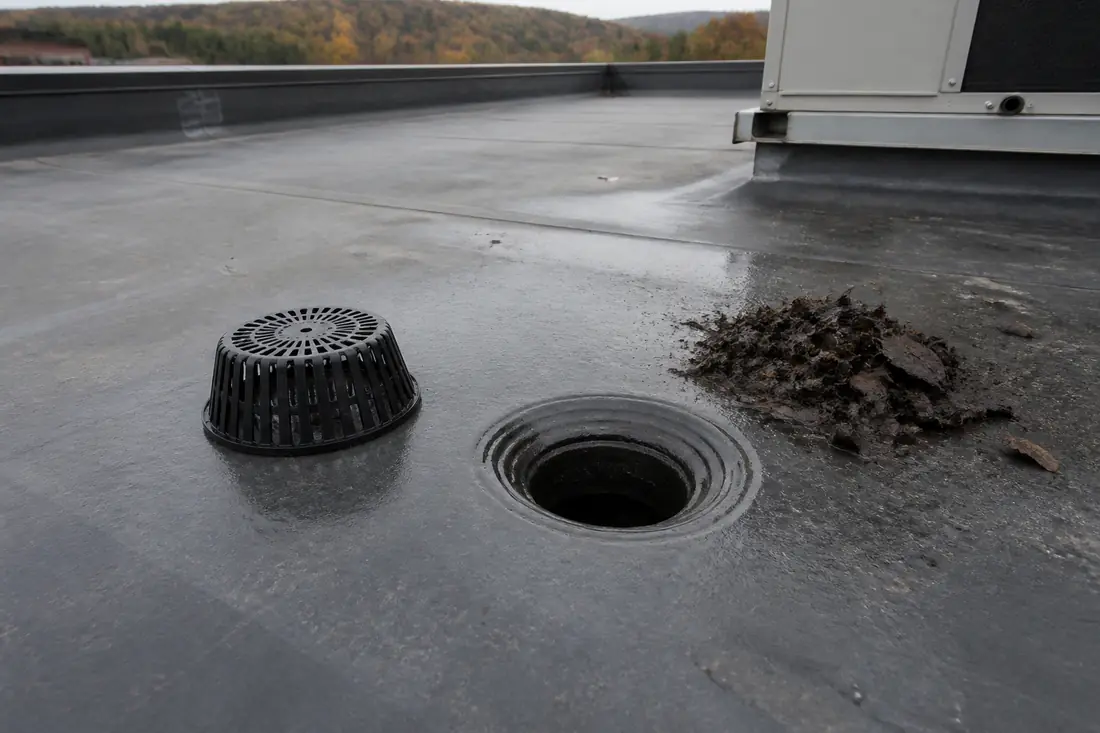
Scheduled inspection, drain clearing and minor repair — the cheapest roof spending you will ever do.
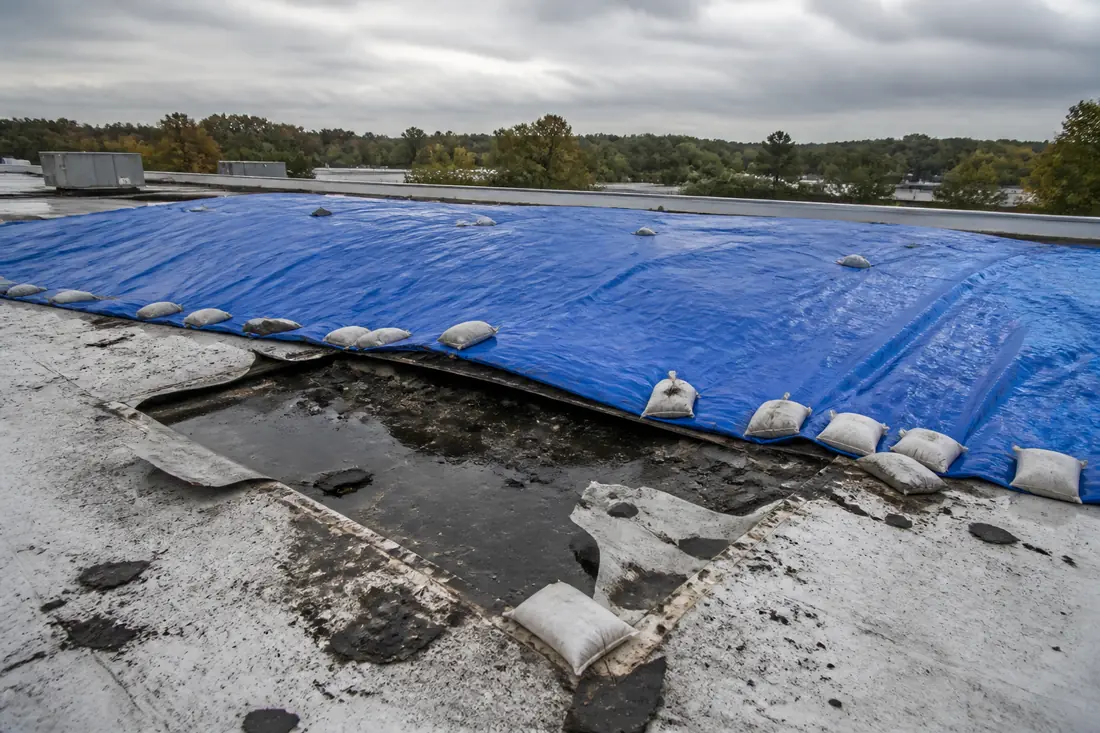
Rapid temporary stabilization of active leaks and storm damage to stop losses inside the building.
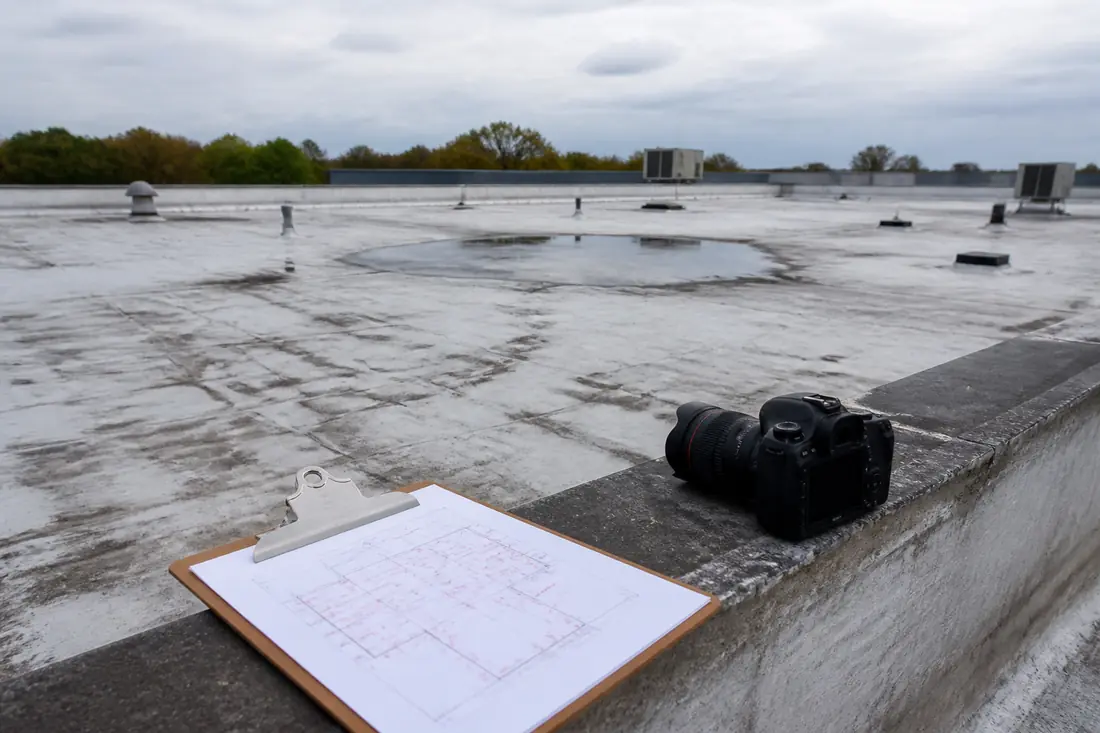
Documented condition assessment with remaining service life — for budgets, due diligence and insurance.
Silicone and acrylic coating systems that extend the life of a sound roof without a tear-off.
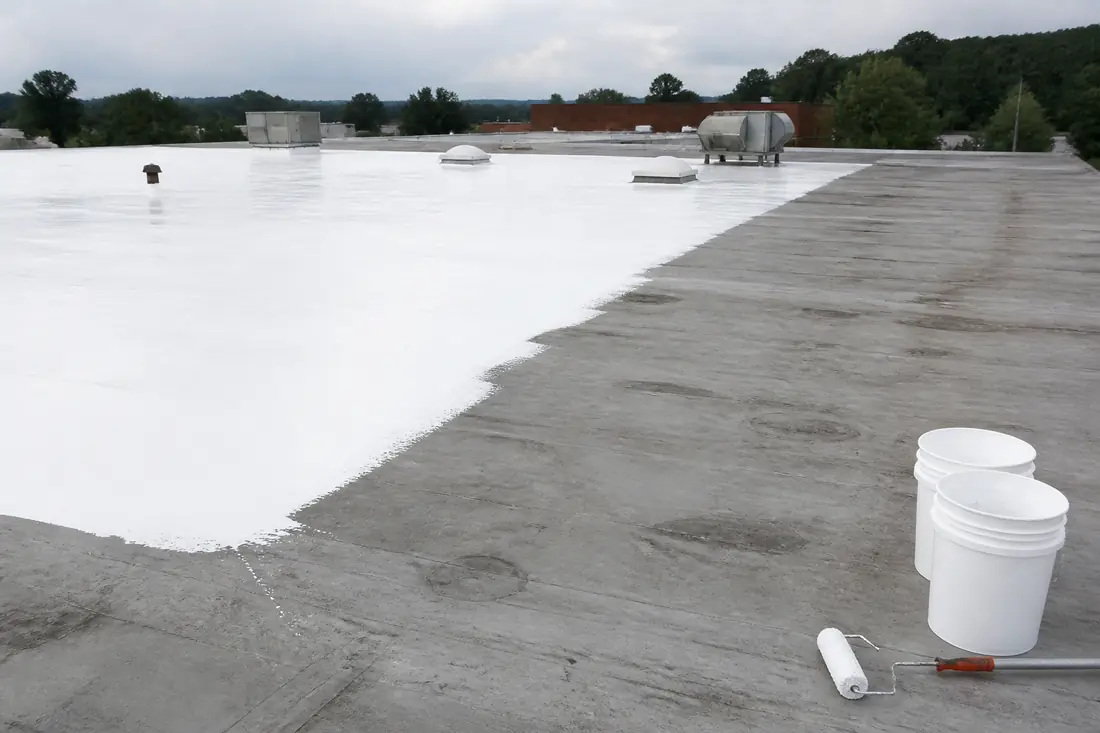
Silicone and acrylic coating systems that extend the life of a sound roof without a tear-off.
Internal drains, scuppers and overflow provision — designed, repaired and cleared so water leaves the roof.
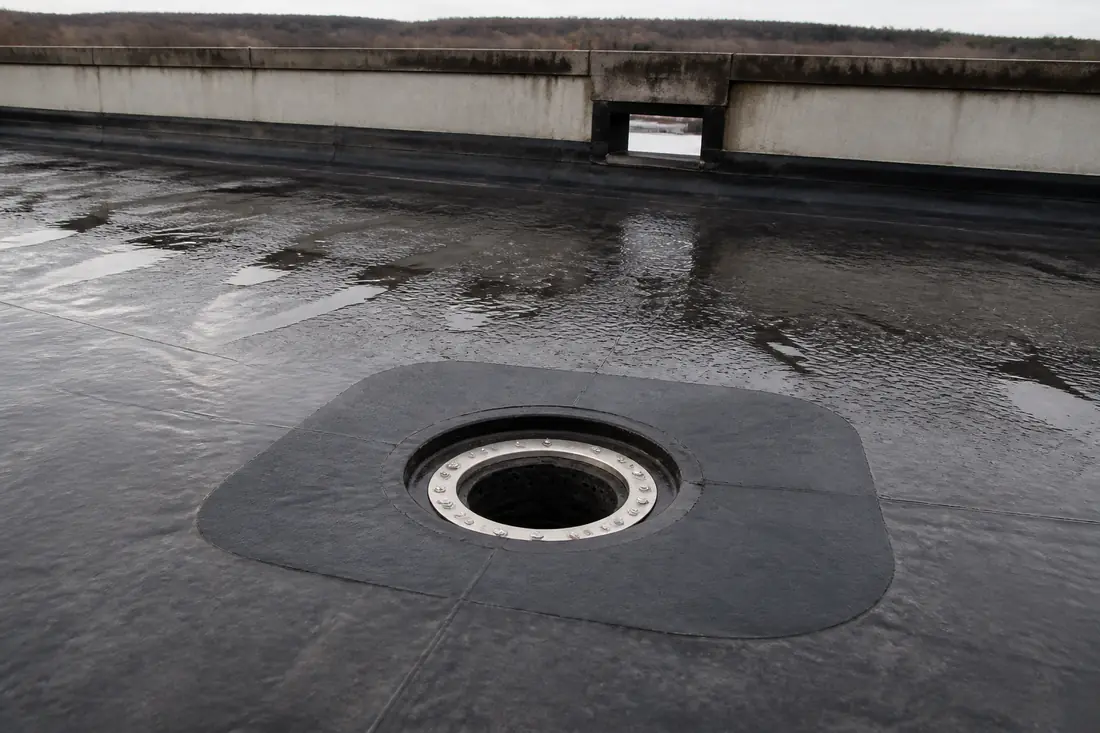
Internal drains, scuppers and overflow provision — designed, repaired and cleared so water leaves the roof.
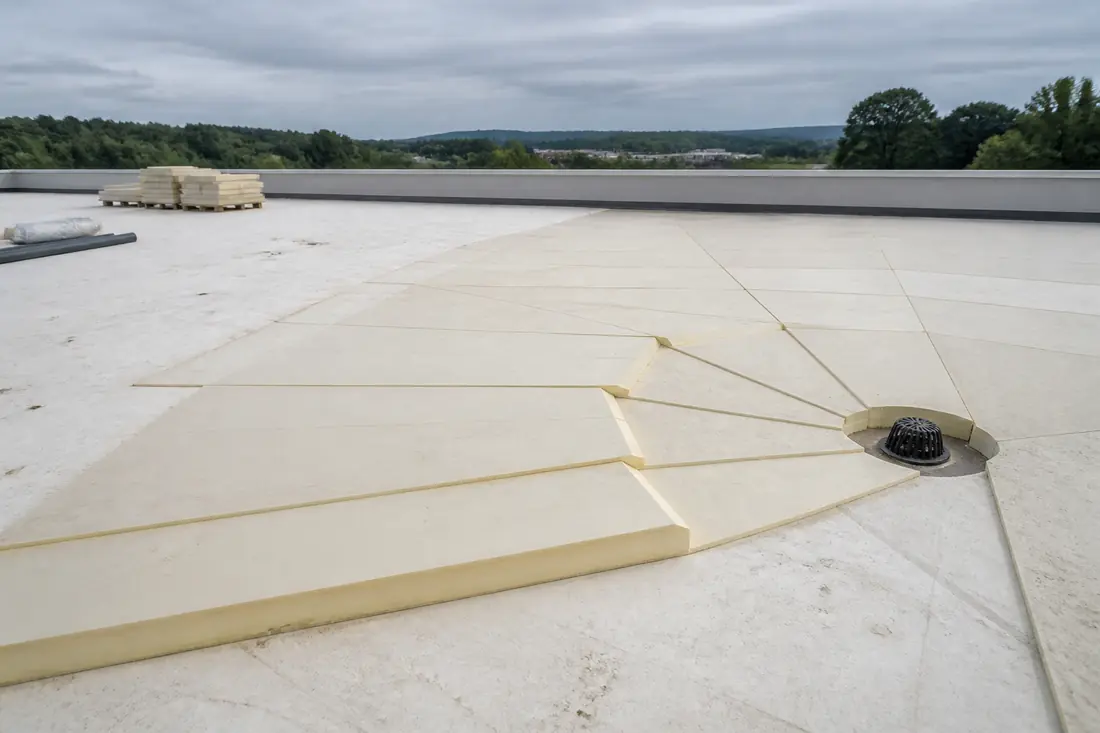
Building positive slope into a flat roof with tapered insulation and crickets so water reaches the drains.
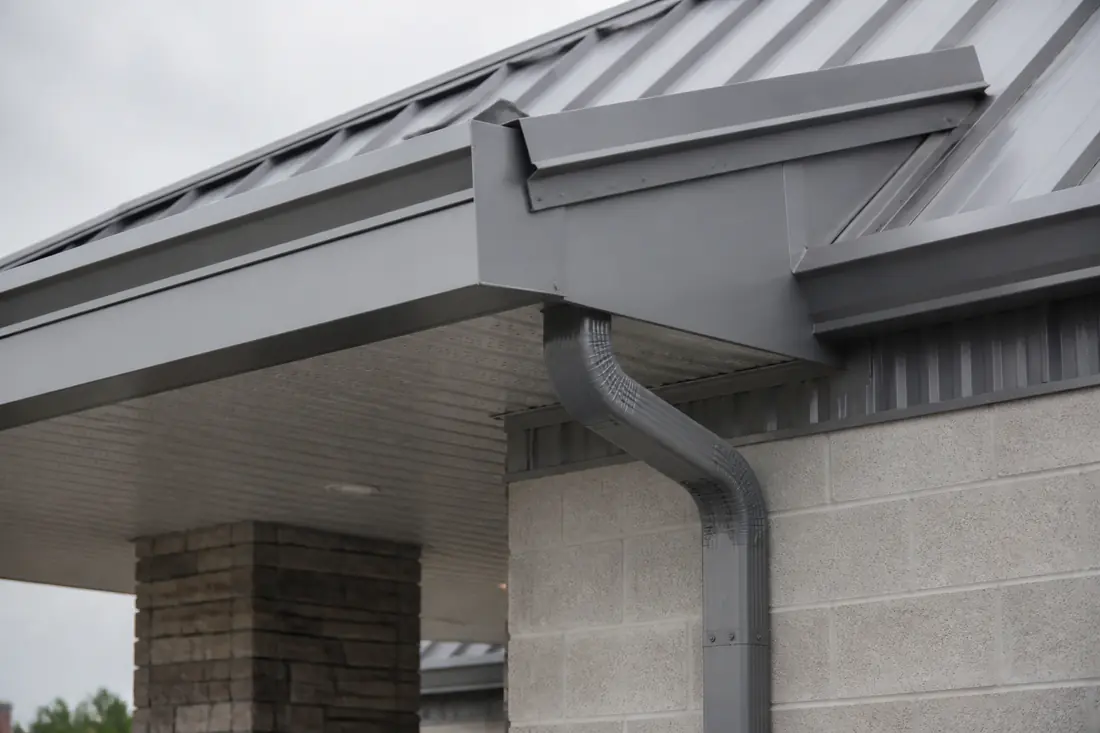
Commercial-scale gutters, downspouts, soffit and fascia — the exterior envelope that carries roof water to the ground.
Large-area low-slope roofing for warehouses and distribution centers, where the roof is mostly open field and the risk is what sits beneath it.
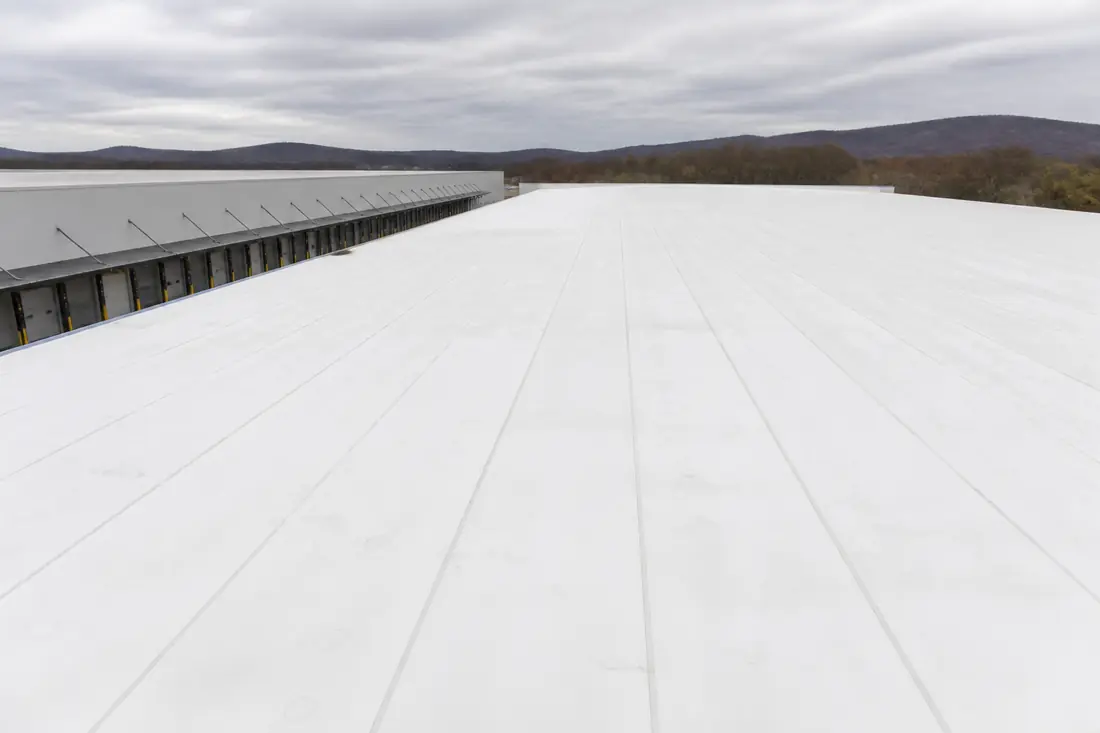
Large-area low-slope roofing for warehouses and distribution centers, where the roof is mostly open field and the risk is what sits beneath it.
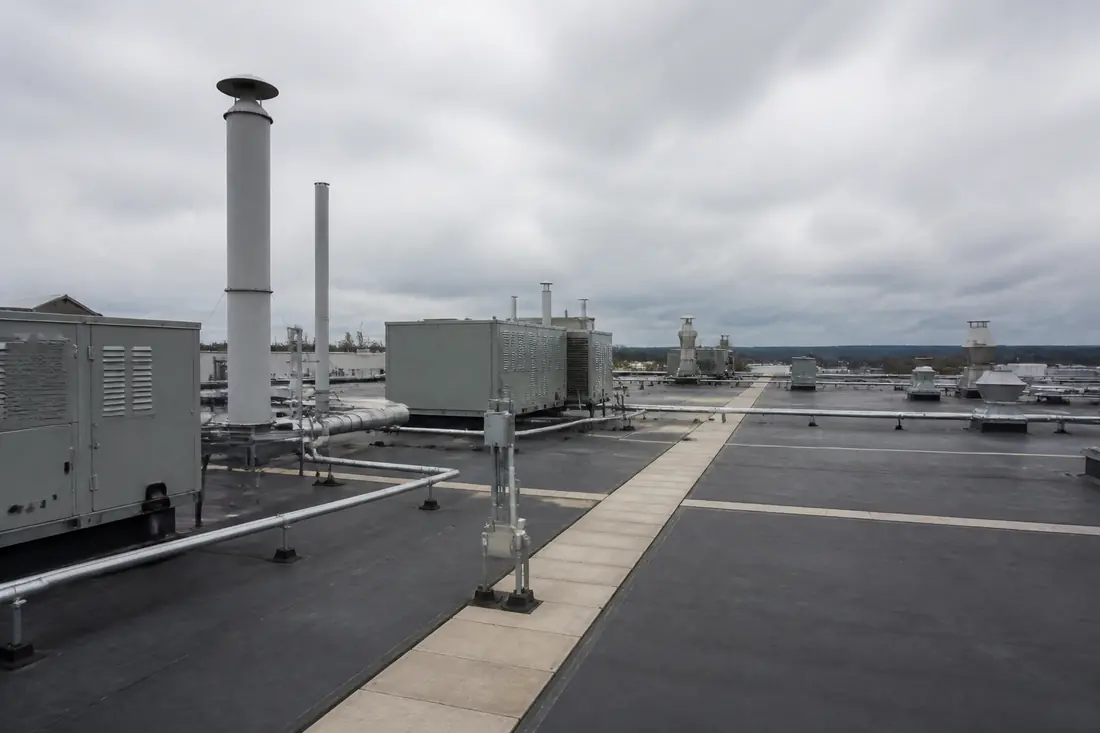
Roofing for manufacturing and process facilities, where exhaust, heat and continuous operation dictate the membrane as much as the weather does.
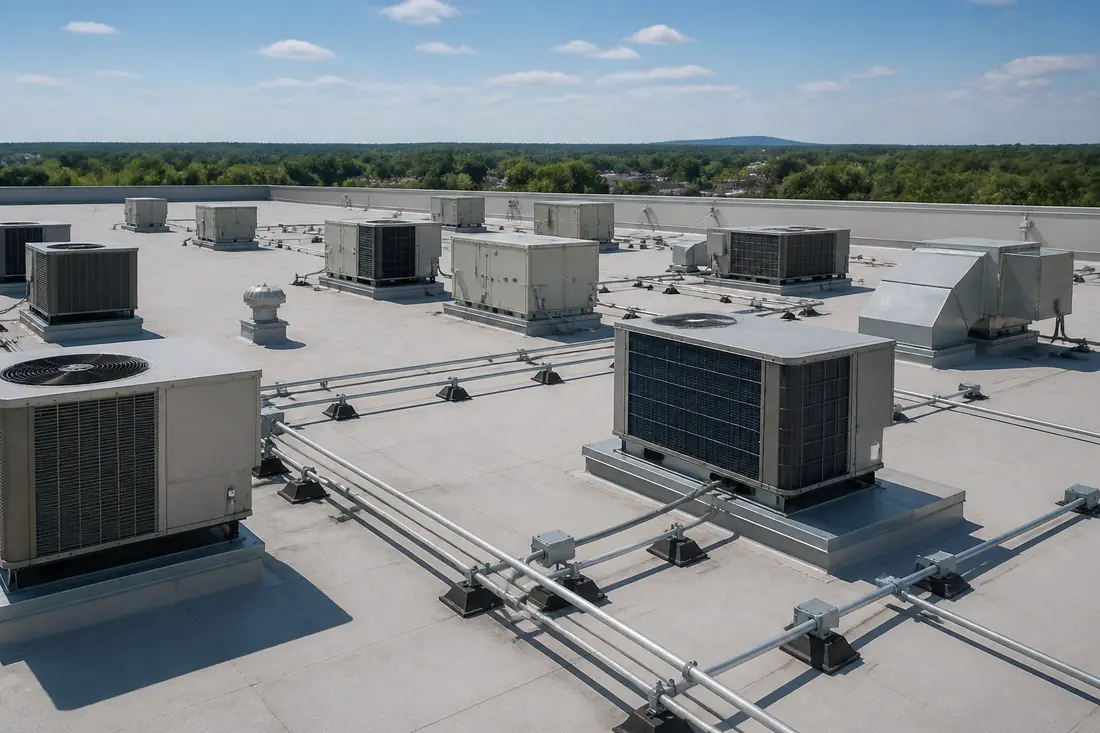
Roofing for occupied office buildings, where noise, odor and tenant disruption are constraints on the work rather than afterthoughts.
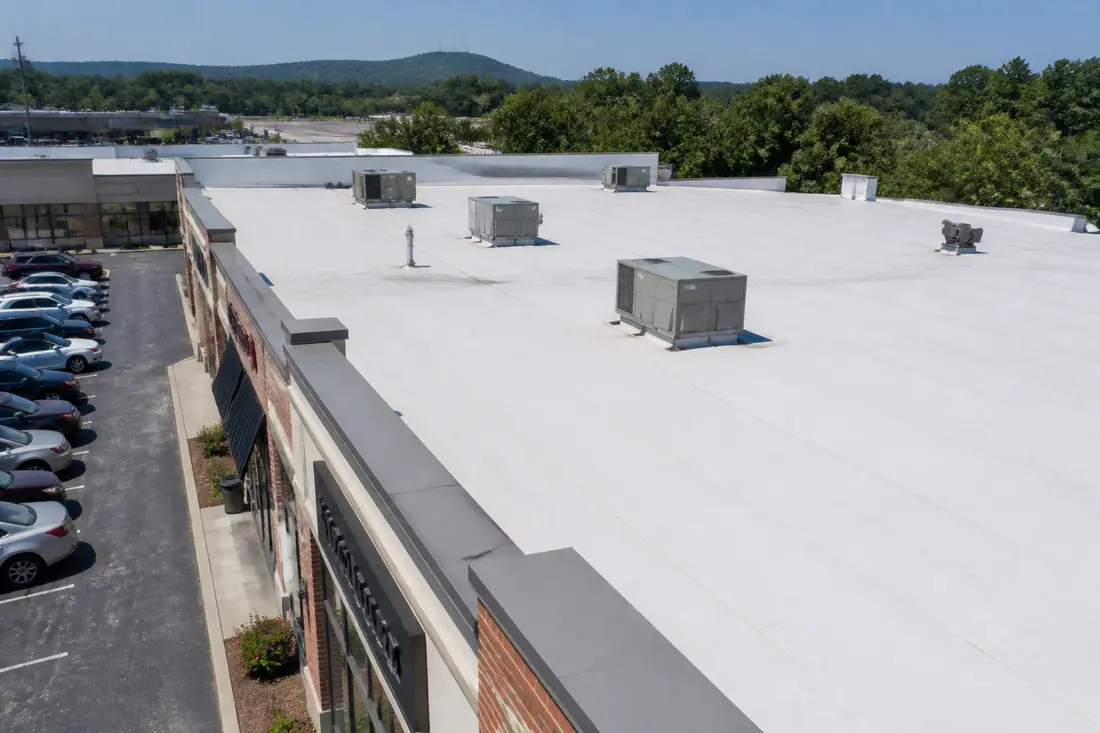
Roofing for stores, strip centers and shopping centers, where trading hours, customer access and multiple tenants shape the work.
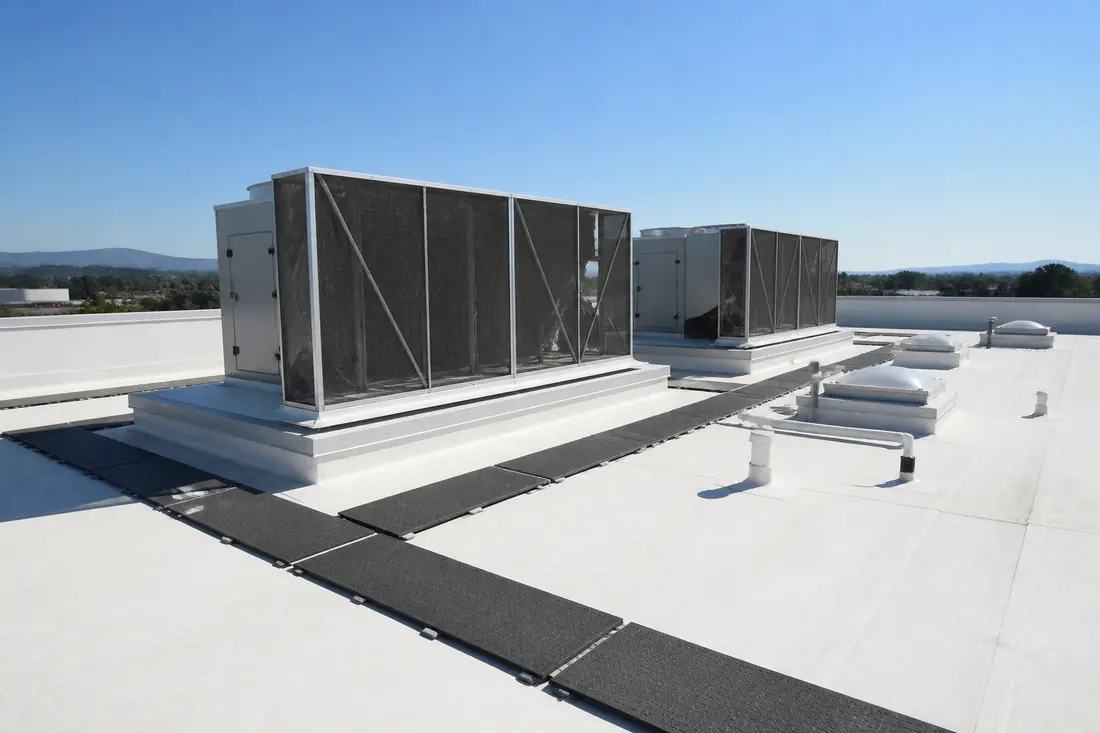
Roofing for clinics, surgeries and healthcare facilities, where infection control, air handling and continuous operation govern how the work is done.
Every service we offer, and what the work actually looks like.
Your request is read and sorted by urgency rather than dropping into a queue. Marking the job urgent on the form changes how quickly it gets looked at.
Work of this kind is assessed in person rather than quoted from a phone description, so the scope and the price are both settled before anything starts.
You see the options and the cost before any work starts, and a cheaper repair that genuinely solves the problem should be presented alongside the bigger one.
Removed material is hauled away and the site left clean. Cleanup belongs in the job rather than being an extra you have to ask for.
If any of this looks like your property, it is worth getting eyes on it before the next wet season.
Ponding that has not drained within about 48 hours means the roof is not shedding water. It adds dead load, accelerates membrane ageing and finds every weak seam.
A leak that returns after being patched usually means the patch was applied where the water appeared rather than where it enters. The entry point is often well upslope.
Blistering means moisture or air trapped under the membrane. Open seams mean a weld or adhesive bond that failed. Both spread if left through a summer.
Wind uplift, hail bruising and debris punctures all need documenting before anything is covered over, because an adjuster is comparing damage against pre-existing wear.
Blocked primaries with no working overflow can accumulate serious weight in one storm. Clearing drains is the cheapest roof work there is and the most often skipped.
A roof approaching the end of its service life needs a dated condition report and a service life estimate before it becomes an emergency in someone else’s budget year.
The right system depends on the deck, the slope, the building below and how long the roof has to last before it is touched again. Here is how they compare.
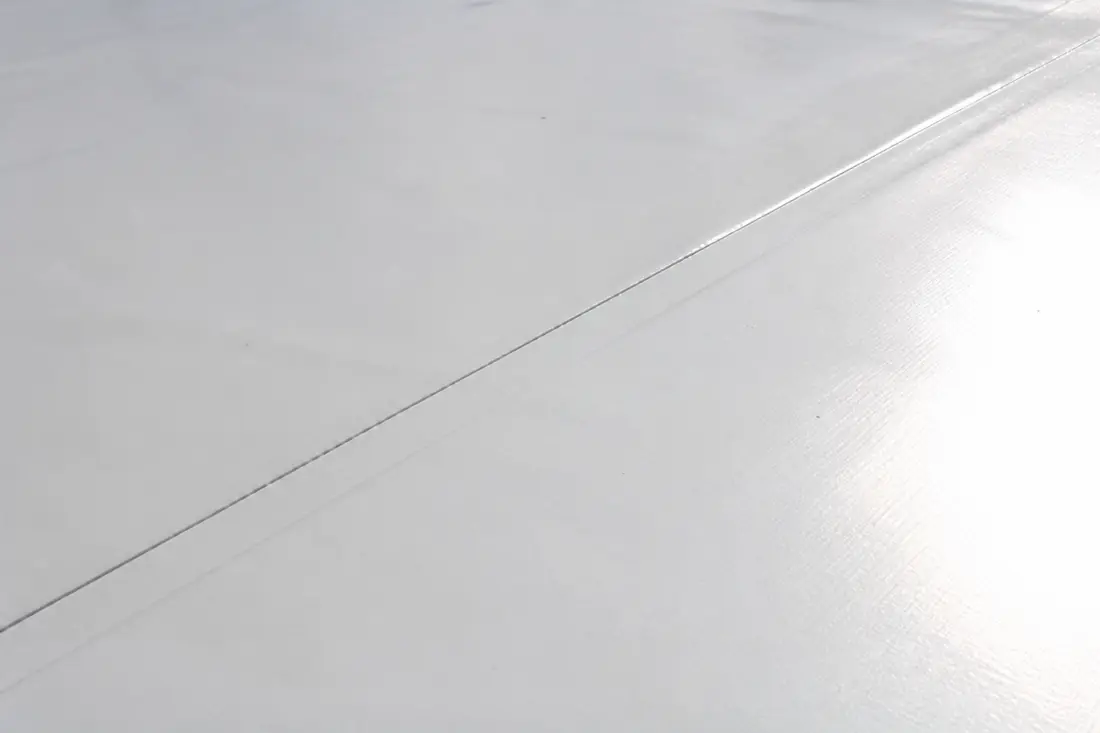
Heat-welded thermoplastic membrane with a reflective white surface. The default for new commercial construction, and strong on cooling load in the Alabama summer.
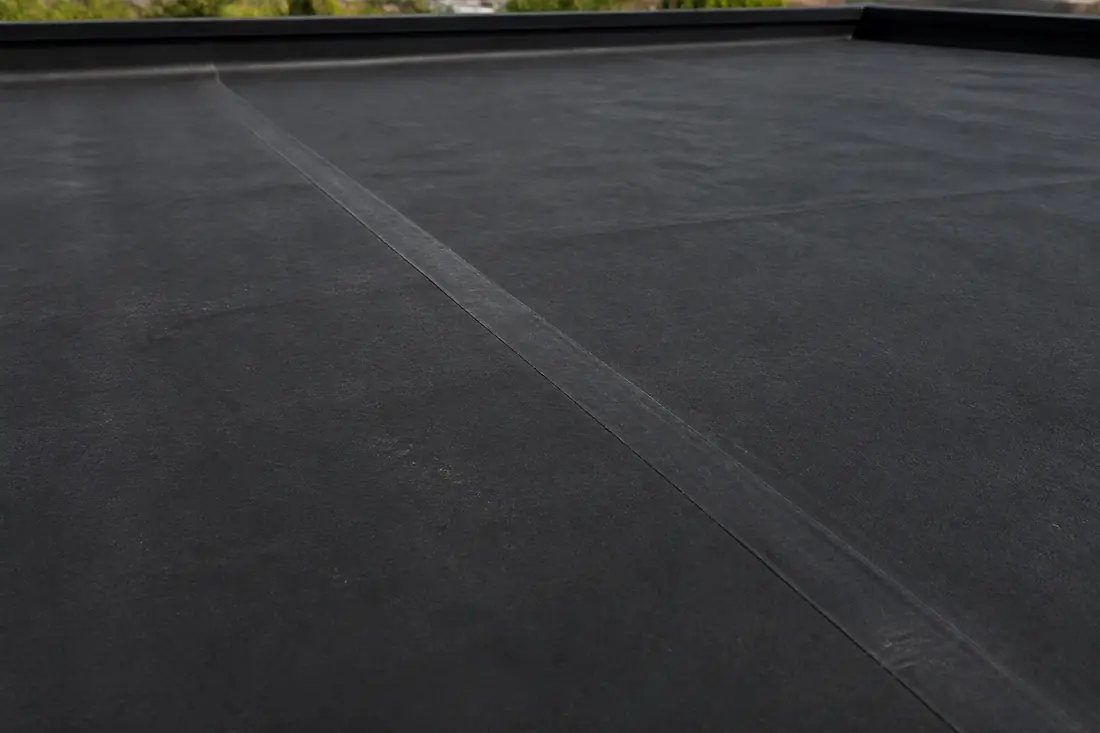
Synthetic rubber membrane with the longest field record of any single-ply. Excellent thermal cycling tolerance; EPDM is a durable synthetic-rubber membrane with a long history in commercial roofing. It is available in mechanically attached, adhered and ballasted assemblies, with seam and flashing details selected for the specific system.
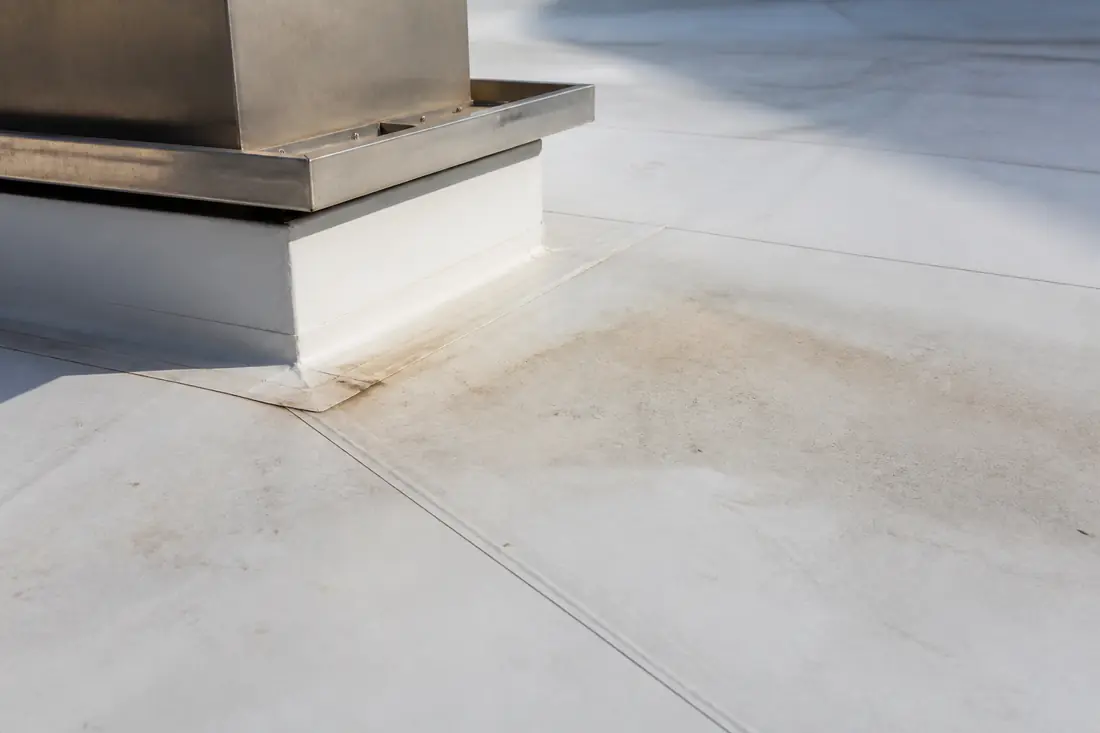
Heat-welded thermoplastic that resists animal fats, oils and many industrial chemicals. Costs more than TPO and earns it only where there is chemical exposure.
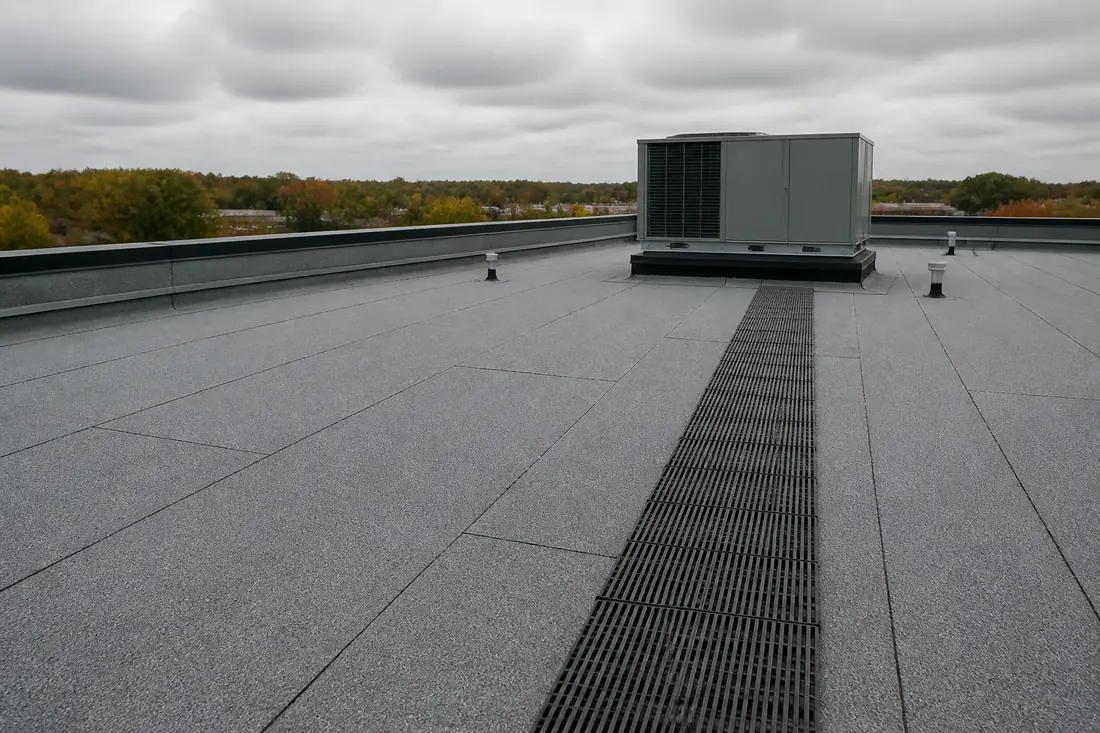
Polymer-modified asphalt in two or more reinforced plies. Multiple reinforced layers between the weather and the deck, which matters on roofs walked for equipment service.
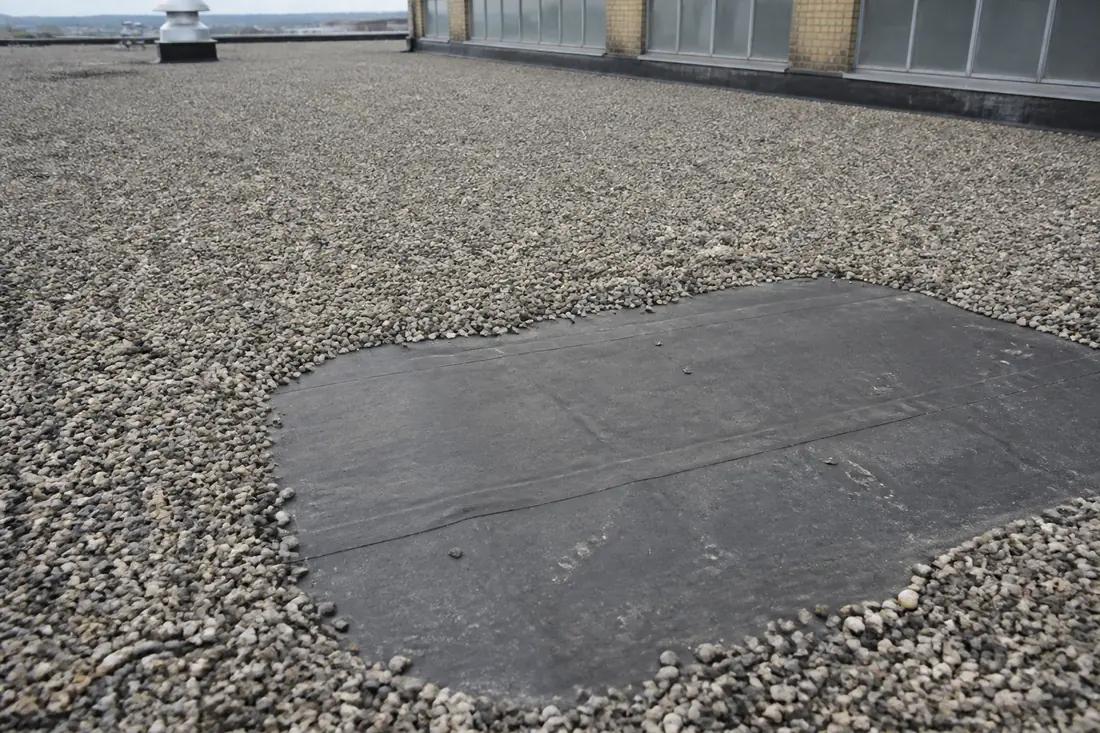
Alternating bitumen and reinforcing felt plies under gravel or a cap sheet. Highly redundant and long-lived, but leak tracing under aggregate is slow work.
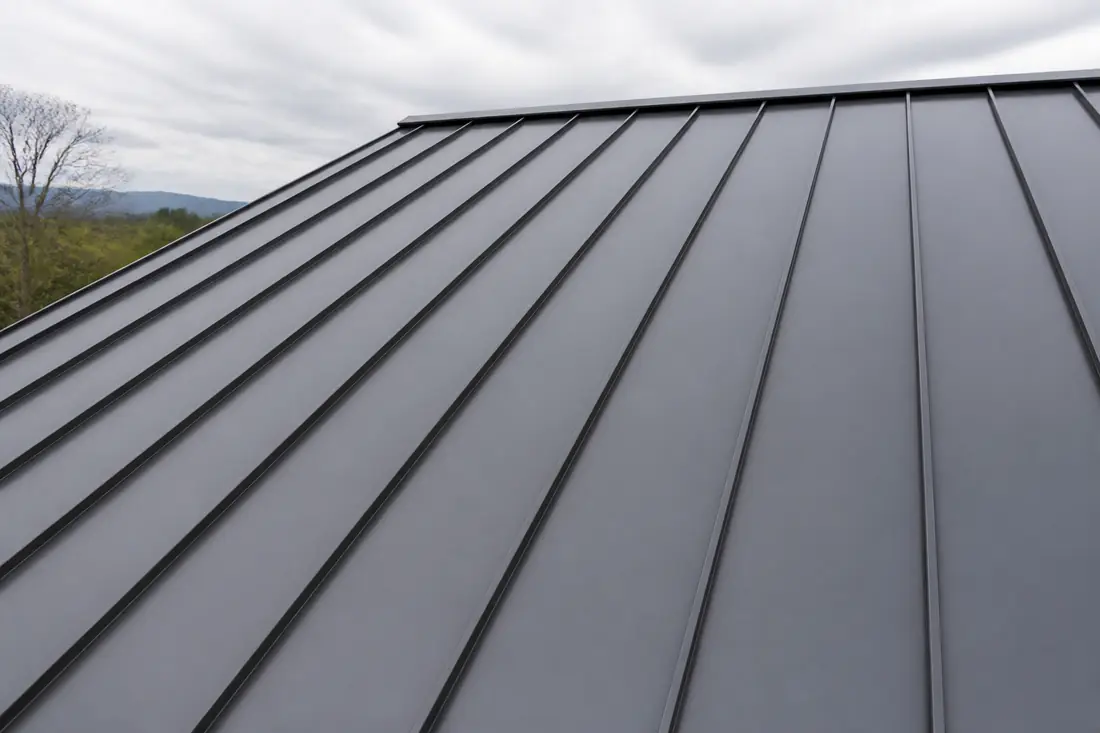
Concealed-fastener metal panels that allow thermal movement. Long service life on steep-slope and warehouse roofs; exposed-fastener panels fail at their gaskets instead.
EPDM, TPO, PVC, KEE and CSPE each answer to a different ASTM standard in the building code. What that means when three bids all say "single-ply" and none of them match.
Read the guide →Fall protection is a real line item on a commercial roof. What the federal rules require, why a parapet changes the number, and what a cheap bid is usually leaving out.
Read the guide →Wind corners a low-slope roof at the perimeter, and IBC Section 1504.5 exists because of it. What ES-1 tests, why edge metal is structure, and what to check.
Read the guide →12 cities and the communities around them. Not sure if you are covered? Call and ask — we will tell you straight.
Cummings Research Park · Downtown · Jones Valley · Five Points
35801, 35802, 35805, 35806, 35810
Downtown Madison · Clift Farm · Town Madison
35756, 35757, 35758
Downtown Decatur · Beltline · Riverside
35601, 35603
Downtown Athens · US-72 corridor
35611, 35613, 35614
35640
35603
35759
35749
35763
35760
35756
35748
It is priced per square foot of roof area, but the range is wide enough that a number without a site visit would be misleading. What moves it most is the system specified, whether the existing roof is torn off or recovered, how much deck and insulation needs replacing, how many penetrations and curbs need flashing, and access — a roof reached only by crane prices differently from one with stair access. We quote after a survey, and the survey is free.
Yes, and on most commercial jobs that is the constraint the whole schedule is built around. Only as much roof comes off in a day as can be made watertight before the crew leaves, work is phased by section, and noisy or disruptive operations can be scheduled for nights and weekends. Tell us what cannot be interrupted and we plan around it rather than discovering it on day two.
It depends on how much of the roof is genuinely sound and whether the insulation beneath is dry. Scattered defects on a dry roof are worth repairing. Widespread saturation is not, because a repair over wet insulation seals the water in. We moisture-survey before advising, and we price both options with a remaining service life estimate on each so you are comparing rather than taking our word for it.
Service life depends far more on drainage and maintenance than on the membrane brand. A single-ply roof that drains properly and gets inspected twice a year will considerably outlast an identical roof that ponds and is never walked. Roofs that fail early nearly always failed on water sitting somewhere it should not, or on a detail at a penetration.
Ponding is water still standing on the roof roughly 48 hours after rain. It matters because it magnifies UV degradation, adds dead load the structure may not have been designed for, encourages growth, and finds any marginal seam. Most manufacturers also exclude ponding-related damage from their warranties, so it can quietly void the coverage you paid for.
Often, if the roof is structurally sound and the insulation is dry. A restoration coating seals seams and small defects and adds years for a fraction of replacement cost. But a coating over saturated insulation traps the water and accelerates deck corrosion, so we survey for moisture first and will tell you when the answer is no.
We document damage in the form an adjuster needs — dated photographs taken before any temporary work covers the evidence, mapped against a roof plan, with damage distinguished from pre-existing wear. We do not negotiate the claim on your behalf or advise on coverage; that is between you and your insurer, and a contractor who promises otherwise is a warning sign.
Twice a year suits most buildings here, timed after the spring storm season and before winter, plus a check after any severe weather event. Buildings with heavy rooftop equipment traffic or significant tree cover need it more often. The inspection itself is cheap; what it prevents is not.
Manufacturer material warranties are available on qualifying assemblies, and they are conditioned on the roof being installed to the manufacturer’s published specification and maintained afterwards. Workmanship coverage is separate and is stated in writing in the proposal. We will explain exactly what each covers and what voids it before you sign anything.
A thirty-mile radius around Huntsville, which takes in Madison, Decatur, Athens, Hartselle, Priceville, Meridianville, Harvest, Owens Cross Roads, New Hope, Triana and Gurley. We keep to that ring deliberately — response time on an emergency leak call is part of the service, and it stops being credible at a two-hour drive.
Call (256) 908-8825 or request a callback — whichever is easier.