PVC Roofing in Huntsville, AL — What to Expect
PVC is a heat-welded thermoplastic like TPO, but its chemistry resists animal fats, oils and many industrial chemicals that will soften and degrade other membranes. That single property is why it exists on the roofs it exists on.
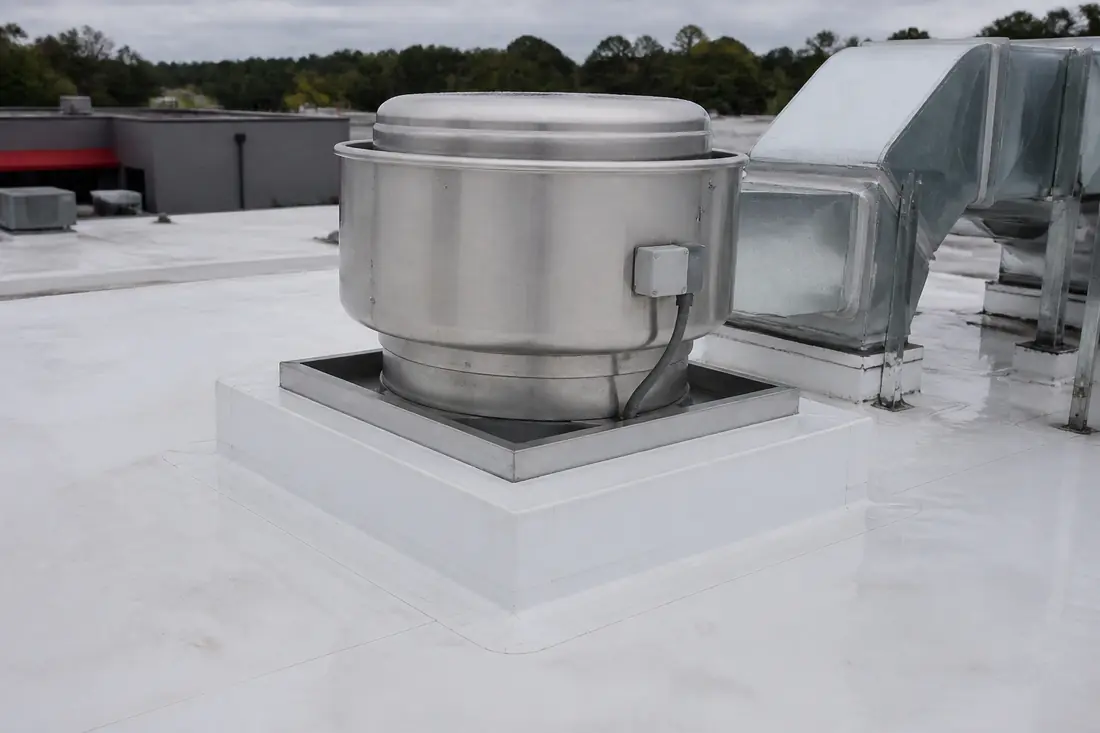
If your building has kitchen exhaust, a grease hood, or process exhaust carrying oils or solvents, the area downwind of that vent is where a roof dies first. We have opened up TPO and EPDM roofs around restaurant exhaust where the membrane had gone soft and pliable while the rest of the roof was in good condition.
PVC costs more per square foot than TPO, and on a building with no chemical exposure that premium buys you little. On a restaurant, a food plant or a manufacturing facility, it is usually the difference between a roof that lasts its expected life and one that needs a patch every year.
What Is Included
- Heat-welded seams inspected and tested to manufacturer requirements, the same as TPO
- Resistant to animal fats, cooking oils and many industrial chemicals
- Standard choice around kitchen and process exhaust
- Reflective membrane options for cooling load
- Detailed grease-containment flashing at exhaust curbs
- Specified only where chemical exposure justifies the cost
The PVC Roofing Process
- 1
Step 1: Chemical Exposure Assessment
We identify what the roof is actually exposed to — kitchen grease, process exhaust, solvents — and where. That mapping decides whether PVC is justified and which areas need extra protection.
- 2
Step 2: System Specification
Membrane thickness, reinforcement and attachment are specified, along with compatible flashings. PVC is not compatible with asphalt-based materials, so every transition detail has to be planned.
- 3
Step 3: Substrate Preparation
Tear-off or preparation, deck repair, and installation of insulation and cover board, with separation layers wherever the new membrane would otherwise contact incompatible material.
- 4
Step 4: Membrane Installation and Welding
Sheets laid out, attached and hot-air welded exactly as TPO. Heat-welded seams are inspected and tested as required by the roofing system manufacturer and project specifications, with deficient welds repaired and retested before completion.
- 5
Step 5: Exhaust and Grease Detailing
Kitchen and process exhaust curbs get containment detailing so discharge is caught rather than running across the membrane, which is the single most valuable detail on a restaurant roof.
Types of PVC Roofing in Huntsville
Restaurant and Commercial Kitchen Roofs
PVC around grease-laden exhaust, with containment at the hood curbs. The application where the material premium most obviously pays for itself.
Food Processing and Manufacturing
Roofs exposed to process exhaust carrying animal fats, oils or chemicals, where standard membranes soften and fail locally.
Fleeceback PVC Systems
Membrane with a fleece backing for adhesion over difficult substrates and for improved puncture resistance on roofs that take traffic.
Localised PVC Replacement
Replacing a failed area around an exhaust vent with PVC and detailing the transition, rather than replacing an otherwise sound roof.
What Matters When Choosing a Roof Systems Contractor in Huntsville, AL
We work around your operations
Occupied buildings do not stop for a roof. Phasing, night and weekend work, and protection of what is underneath are planned before mobilisation, not improvised on day one.
Drainage assessed before membrane
Most premature membrane failure we are called to is a drainage problem wearing a membrane costume. Slope, drains and scuppers get surveyed before anyone specifies a system.
Written scope, photographed condition
You get a documented scope and photographs of what was found and what was done, which is what a facility manager needs for a capital file and an insurer needs for a claim.
Installed to manufacturer specification
Fastener patterns, seam widths and flashing details follow the system manufacturer’s published requirements, because that is what a material warranty is conditioned on.
Repair quoted against replacement
When a roof is near end of life we price the repair and the replacement side by side with remaining service life on each, rather than selling whichever is larger.
Clean sites, protected tenants
Debris containment, magnet sweeps and protected walkways matter more on an occupied retail or medical building than on any residential job.
PVC Roofing FAQs
Why is PVC used on restaurant roofs?
Animal fats and cooking oils from kitchen exhaust chemically attack most roofing membranes, softening them until they fail. PVC resists that attack. On a restaurant, the area downwind of the hood is where a standard membrane dies first, often within a few years.
Is PVC worth the extra cost over TPO?
Only where there is chemical exposure. On a plain office or warehouse roof the premium buys you very little and TPO is the sensible specification. On a building with grease or process exhaust it is usually cheaper over the roof's life than replacing a TPO roof early.
Can PVC be installed over an asphalt roof?
Not in direct contact — plasticisers migrate and the membrane degrades. It needs a separation layer or cover board between the PVC and any asphalt-based material. This is a common and expensive mistake to find later.
Does PVC become brittle with age?
Older PVC formulations could lose plasticiser and become brittle. Modern membranes are formulated against that and perform far better, but it is a fair question to ask of any manufacturer, and worth checking what their warranty actually covers.
Can PVC and TPO be used on the same roof?
They can coexist on a building but they are not weldable to each other, so any junction has to be a properly detailed transition rather than a weld. We generally use PVC across the affected zone with a designed transition rather than patching one into the other.
Other Services in Huntsville
- EPDM RoofingEPDM rubber membrane roofing — the longest field track record of any single-ply system, in black or white.
- TPO RoofingHeat-welded TPO single-ply membrane — the reflective white system most new North Alabama commercial roofs are built with.
- Built-Up Roofing (BUR)Traditional multi-ply built-up roofing — alternating bitumen and reinforcing felts with a gravel or cap surfacing.