Built-Up Roofing (BUR) in Huntsville, AL — What to Expect
Built-up roofing is the oldest low-slope system still specified, and the reason it survives is redundancy. Alternating layers of bitumen and reinforcing felt build a membrane several plies thick, so a puncture that would end a single-ply roof goes through one layer of several.
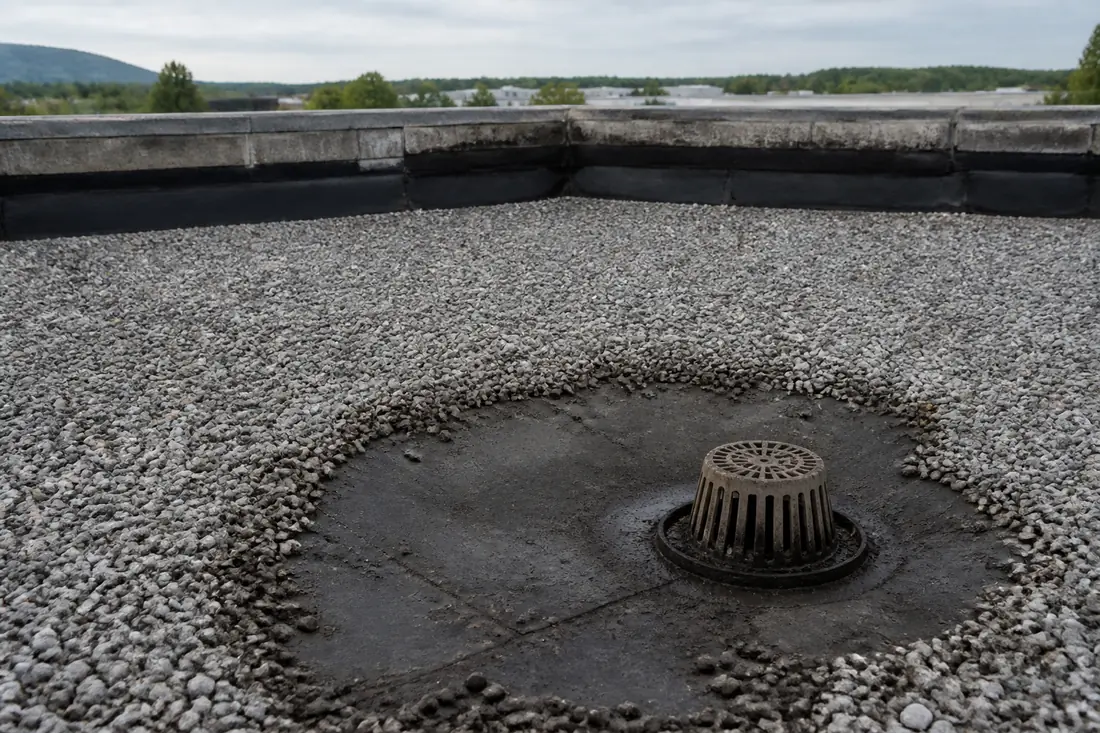
Surfacing is either aggregate or a mineral cap sheet. Gravel protects the plies from UV and adds ballast and fire resistance, though it makes leak tracing considerably harder — the water entry point can be well away from where it shows inside, and the gravel has to be cleared to find it.
Most of our built-up work now is maintaining, repairing and eventually replacing existing BUR roofs across older Huntsville industrial and institutional buildings. New BUR installations are rarer, but there are buildings where it is still the right specification and we will say so.
What Is Included
- Multi-ply bitumen and reinforcing felt assemblies
- Aggregate or mineral cap sheet surfacing
- Repair and maintenance of existing BUR roofs
- Redundancy against punctures and foot traffic
- Honest comparison against single-ply for replacement
- Tie-in detailing where BUR meets newer systems
The Built-Up Roofing (BUR) Process
- 1
Step 1: Existing BUR Condition Survey
The roof is surveyed and, where needed, cut-tested to see how many plies are present, how they are bonded and whether the insulation beneath has taken water.
- 2
Step 2: Repair or Replace Assessment
We establish whether the roof is repairable. Built-up roofs often have decades of patching on them, and there is a point where further repair stops being economic — we say when that point has passed.
- 3
Step 3: Aggregate Removal and Preparation
Where work is needed, gravel is cleared from the work area and the plies exposed and prepared. This is slow work and is a real part of the cost on any aggregate roof.
- 4
Step 4: Ply Installation or Repair
Plies installed or repaired with compatible bitumen, laps staggered, and the repair tied into the surrounding roof rather than simply laid on top of it.
- 5
Step 5: Surfacing and Reinstatement
Aggregate reinstated or cap sheet applied, drains cleared of displaced stone, and the roof left with drainage functioning.
Types of Built-Up Roofing (BUR) in Huntsville
BUR Repair and Patching
Localised repair of blisters, splits and failed flashings on existing built-up roofs, tied properly into the surrounding plies.
Aggregate Roof Leak Investigation
Tracing leaks under gravel, which needs systematic clearing rather than guesswork — the reason BUR leak calls take longer than single-ply ones.
BUR Recover and Replacement
Replacing an end-of-life built-up roof, usually with a modern single-ply or modified bitumen system, with an honest comparison of the options.
Flashing and Base Flashing Rebuild
Rebuilding wall and curb flashings, which on older BUR roofs is where the great majority of leaks actually start.
What Matters When Choosing a Roof Systems Contractor in Huntsville, AL
We work around your operations
Occupied buildings do not stop for a roof. Phasing, night and weekend work, and protection of what is underneath are planned before mobilisation, not improvised on day one.
Drainage assessed before membrane
Most premature membrane failure we are called to is a drainage problem wearing a membrane costume. Slope, drains and scuppers get surveyed before anyone specifies a system.
Written scope, photographed condition
You get a documented scope and photographs of what was found and what was done, which is what a facility manager needs for a capital file and an insurer needs for a claim.
Installed to manufacturer specification
Fastener patterns, seam widths and flashing details follow the system manufacturer’s published requirements, because that is what a material warranty is conditioned on.
Repair quoted against replacement
When a roof is near end of life we price the repair and the replacement side by side with remaining service life on each, rather than selling whichever is larger.
Clean sites, protected tenants
Debris containment, magnet sweeps and protected walkways matter more on an occupied retail or medical building than on any residential job.
Built-Up Roofing (BUR) FAQs
Is built-up roofing obsolete?
Not obsolete, but rarely specified new. Single-ply installs faster and cheaper for comparable performance. There is a very large stock of existing BUR on older Huntsville industrial and institutional buildings, and much of it is worth maintaining rather than replacing.
Why is finding a leak in a gravel roof so difficult?
The gravel hides everything, and water entering at one point travels between plies before it appears inside. Locating the entry means clearing aggregate systematically across a suspect area. It is honest work but it is slow, and any quote that pretends otherwise is guessing.
What is a blister and does it need fixing?
A pocket of air or moisture trapped between plies that expands as it heats. Small stable blisters can often be left and monitored. Ones that are growing, or that sit where people walk, should be cut open, dried and repaired before they split.
Should I replace my BUR roof with single-ply?
Usually, when it reaches end of life. You get a lighter assembly, faster installation, easier future leak tracing and better reflectivity. We will price both a like-for-like BUR replacement and a single-ply alternative so the comparison is real.
How long do built-up roofs last?
They are among the longest-lived low-slope systems when maintained, which is why so many are still in service. The plies are redundant and the aggregate protects them from UV. Failures cluster at flashings and drains rather than in the field.
Other Services in Huntsville
- Industrial and Manufacturing RoofingRoofing for manufacturing and process facilities, where exhaust, heat and continuous operation dictate the membrane as much as the weather does.
- Warehouse and Distribution RoofingLarge-area low-slope roofing for warehouses and distribution centers, where the roof is mostly open field and the risk is what sits beneath it.
- Commercial Flat RoofingRepair, replacement and maintenance for the low-slope roofs most people call flat — TPO, EPDM, PVC, modified bitumen and built-up.